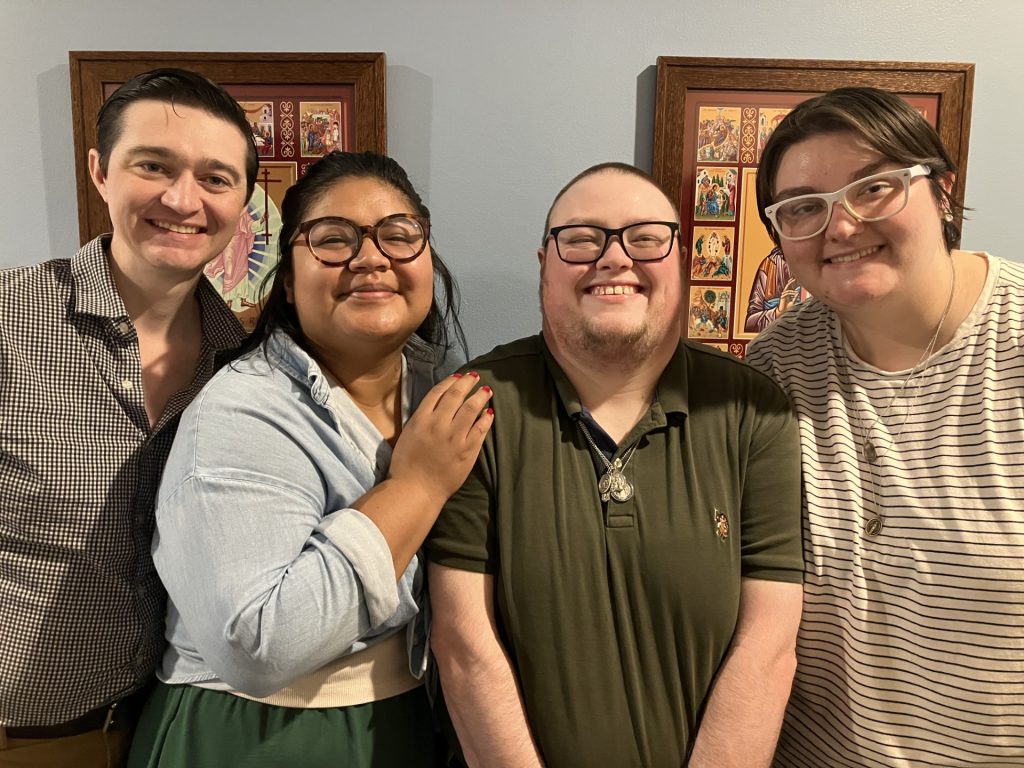
Above photo from left: Brent Martin, Yeni Ramos, Syd Crowder, and Tor Neal.
By Sr. Barbara Blesse, OP
Tor texted: “Hello! Have you read the new encyclical?”
Me (on the third day of my annual retreat): “Yes. Just finished it this morning.”
Tor: “Want to talk about it some time?”
Me (shocked that anyone “in the pews” had actually read the papal document, least of all someone in their 30s): “Sure!”
Two weeks later, Tor and I met and she managed to expand my perspective wider than I could have ever imagined! By the time of our appointment, in addition to having read Pope Leo XIV’s Encyclical Magnifica Humanitas: Safeguarding the Human Person in the Time of Artificial Intelligence, Tor, a “thirty-something life-long learner,” had pursued further research about the impact of artificial intelligence (AI) on society by reading most of the book Empire of AI by Karen Hao.
Early on in our discussion that day, she mentioned Pope Francis’ Encyclical: Laudato Si’: On Care for our Common Home. Thinking she had mixed up the two encyclicals, I realized differently when she made the connection between the two because of the damage that AI data centers do to Earth with their over-consumption of electrical energy and local water supplies, depriving nearby residents of these two resources otherwise needed for their own wellbeing. Unbelievable noise pollution, minimal job opportunities, and negative psychological effects on workers were just a few other topics Tor addressed in that conversation.
She also revealed that three other “thirty-somethings” had joined her in reading the encyclical. One of them, Yeni, in reflecting on the “group experience” said: “’For where two or three gather in my name, I am there with them.’ resonated with me. It wasn’t just the comradeship or united view but the manifestation of the Holy Spirit. It provided me with deeper understanding of what perhaps I might have missed. I believe that being in community is how we were meant to be in this world – no one ever has to do things alone.”
The idea that AI is an unbiased searching tool is laughable at best.
Another friend, Brent, noting he was a Protestant, felt that “the Holy Father’s opinion on the issue of the expanse of Artificial Intelligence is truly founded in a deep concern for humanity and that all individuals should be aware of and take [it] seriously. At this point it is understood that this subject is not one that is going away.”
Syd, yet another friend, observed: “AI in its current form is dangerous for its users, the environment, and the social-economic structures of our world. A very small and specific number of people, unregulated and without an accountability structure, hold all the power for how each AI model is used and what information is presented in it. The idea that AI is an unbiased searching tool is laughable at best. It is allowing a curation of a certain type of culture that the owners and decision makers for that model wish to see the world move toward.”
So how do we meet the challenge that AI, in its current form, poses?
Tor wrote: “I believe there is hope and there is a way forward! We can both embrace technology and be mindful about how we create, train, and produce technology, especially AI. We have to come together as a collective people and advocate for responsible and slower progress over profit. We need to lobby our representatives, attend local protests and rallies, and refuse to use irresponsible and dangerous programs like ChatGPT. We have a duty and a right to fight against the current iteration of AI, for ourselves, for our children, and for our Church.”
Tor succeeded in winning the blessing and support of the parish’s Pastoral Council and will soon be inviting parishioners to gather to explore the implications of AI for humanity. This coming together will offer parishioners the opportunity to learn, share concerns, ask questions, and perhaps brainstorm practical ways to help friends and neighbors to deal with the whole of the AI situation in thoughtful ways that are in keeping with the common good. 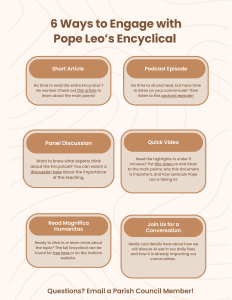
At this gathering, Tor plans to give input from her research with Syd, Yeni, and Brent at her side offering their learnings and viewpoints as young adults as well. Their exercise of critical thinking skills and bold acknowledgement of the many complexities of AI, is impressive. Their collective energy in engaging this issue is palpable.
Carbondale, the city in which our parish resides and home of Southern Illinois University, recently made the decision not to host a data center, effective for at least one year. With faith-filled, active, and caring citizens like Tor, Syd, Yeni, and Brent, perhaps their deeply-held convictions will inspire others in what’s considered by many to be a “small college town” to continue to resist welcoming data centers anywhere far into the future!
