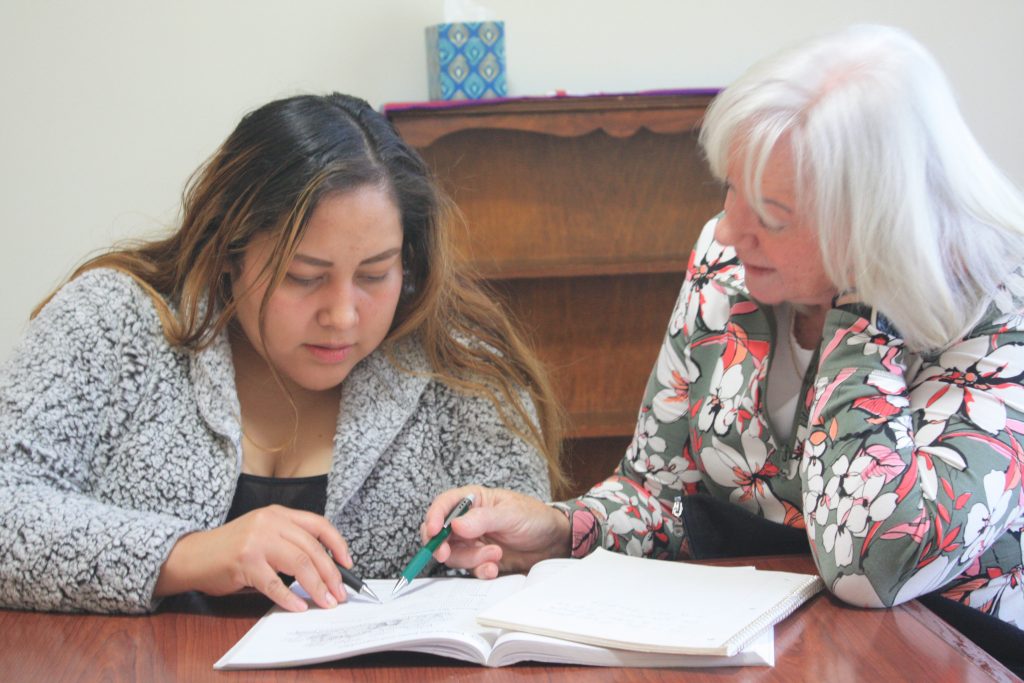
In the Dominican Literacy Center in Aurora, in late August, six of us sat in the gathering room – a perfect name for a place of stories.
We had come together to talk about what we wanted people to know about the Center, what had changed us, what had surprised us and what kept us there. As we talked, another story emerged: the story of a Dominican ministry entering a new chapter.
“We are – all of us together – a learning community.”
The Dominican Literacy Center began in 1993 under the direction of Sr. Kathleen Ryan and a team of Sisters committed to teaching English and offering citizenship classes to immigrant women. For more than three decades, Dominican Sisters have provided leadership for the Center, while lay partners have been essential to its growth. Sr. Kathleen served as its director until 2024, when Claire Wiesner-Smillie, a lay person, became director.
Now, that partnership is taking another step forward. In 2026, the Center expanded its governing membership to include lay leaders. In May, the new members traveled to the Dominican Sisters’ Motherhouse in Springfield, where Sr. M. Paul McCaughey and the Council spent a day orienting them to the Sisters, their mission and the ministry they are helping carry forward.
“The growth of the Dominican Literacy Center has always resulted from the work and wisdom of the Sisters and their lay partners,” says Sr. M. Paul. “Inviting lay women to share in the leadership of the Center serves to ensure the Dominican charism continues with integrity.”
But what, exactly, is being carried forward?
Questions shaped the conversation: What was important about the Center? What surprised them, kept them there, challenged them, or brought them grace? What had this work helped them realize, and what had they come to think about differently?
“Through the stories, I came to see the stamina of our students, how much deeper their well of resilience is than I have had to draw upon. And they are without bitterness.”
Again and again, the group returned to the students whose stories had touched and changed them. Their words spilled out into the room, back and forth among them, each one coming from connections to specific students. Their hearts were full of these women.
One thing they wanted to make clear was that the Center is a community, not simply a collection of individuals. They spoke of creating a welcoming, inviting, safe, and comfortable place where students and staff come to see beauty, wonder, love, and dignity in one another. Though the goals and outcomes are framed around language, they said, everyone helps one another beyond those measurable goals. What matters is that they are all in this together.
Stories permeate the place. Students begin the registration process by telling their stories. The stories are formative of and vital to the community created. The stories are added to and shared more widely.
One staff member reflected on what she had come to see through those stories: the stamina of the students, and how much deeper their well of resilience was than anything she had had to draw upon. And, she noted, they are without bitterness.
“It is not just a product of place. It informs and changes the way you think. If you don’t have language for it, you can’t think it.”
Another staff member reflected on language.
“I have learned this about language: It is not just a product of place. It informs and changes the way you think. If you don’t have language for it, you can’t think it.”
An unplanned conversation about different ways of naming God and Christ became a way to break open that insight.
One day, a student, frustrated by her difficulty learning English, said, “In Spanish I am really smart…”
The words stayed with the staff member who heard them. She realized in a new way how challenging and humiliating it can be to not understand, and how the process can make a person feel infantilized. To some degree, she reflected, you have to be willing to hold that experience in order to learn better.
The stories also open a new, expanding consciousness as staff and students learn about struggles in other countries. They carry forward, in their own connections outside the Center, the ways their experiences there have changed them. Students and tutors have broader views of other cultures through the stories shared. Students and staff are awakened to a sense of justice.
“It is a whole new level of being together and loving each other,” one staff member said.
Things have evolved since the Center's beginning. It now welcomes students from 22 countries. Technology has become increasingly important, and grants allow the Center to keep up with constantly changing technology.
“What I love is that our use of technology is grounded in charism and mission,” one staff member said.
"It is a whole new level of being together and loving each other.”
Connections among the staff, connections with the students, connections to the Dominican way of being, working and relating, and the realization that this work is a call – all of it is held up in a communion of stories.
There is, indeed, lifeblood in stories. Community is formed and nurtured through them, community that holds the past with respect and honor as it looks forward, community that breaks through different kinds of isolation, community that becomes healing and outward-focused.
And thus are we redeemed.
Pedro Casaldáliga, in “The Heart Full of Names,” writes:
“At the end of the road they will tell me
Have you lived?
Have you loved?
And I, without saying anything,
I will open the heart full of names.”
And that is exactly what happened in the gathering room. The women opened their hearts full of names – names of students, names of colleagues, names of people whose stories had changed them.
Perhaps that is how a ministry finds a way forward: not by leaving its story behind, but by opening its heart to those who will carry it into what comes next.
